


Related Content
Articles related to: inequality
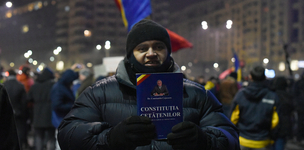
Exploring Europe's ‘Squares of resistance’
Yannicke Goris , Remmelt de Weerd , Rojan Bolling | 19 April 2025Recent mass protests in Eastern Europe deserve our attention. The Broker aims to draw lessons from such movements’ conceptions to outcomes.
▶
Inequality and the SDG agenda: every victory has its price
René Grotenhuis | 23 February 2025Now that inequality has become one of the key SDG issues, all those who have advocated for its inclusion should take note of the drawbacks of this victory.
▶
The Broker’s top recommended articles of 2016
Yannicke Goris , Rojan Bolling | 09 January 2025With the start of a new year, the time has come to reflect on what has passed and look towards what is to come in 2017. A shortlist of 5 unmissable articles published by The Broker in 2016 provides a great start.
▶
Pathways to peace
Mariano Aguirre | December 23, 2024On 10 December, President Juan Manuel Santos received the Nobel Peace Prize in Oslo after successfully negotiating a Peace Agreement between the Colombian government and FARC rebels. However, implementation of the agreement poses many challenges....
▶
Global poverty and national inequality: What’s the connection?
Andy Sumner , Chris Hoy | 21 September 2024Three-quarters of global poverty could be eliminated by addressing inequality and redistributing existing resources within developing countries.
▶
The rebirth of the Eurozone
Evert-jan Quak, Frans Bieckmann | January 21, 2025Is the current recovery policy for the financial and economic crises in the Eurozone a genuine answer for the complexity and diversity of the problems that all member states face? Not really. The responses are too one-sided and mainly export and a...
▶
Debts and imbalances
Evert-jan Quak, Frans Bieckmann | 04 January 2025The structural causes of the euro crisis – high unemployment, low growth rates and debt-ridden states in the eurozone – are not the fault of lazy Greeks, Portuguese and Spaniards. The euro itself cannot be blamed either. The problem is that the Eu...
▶
Capital above labour
Evert-jan Quak , Frans Bieckmann | 04 January 2025Profits are reinvested less in productive sectors, where labour can benefit, and more in capital markets.
▶
Ideals versus reality
Evert-jan Quak, Frans Bieckmann | 18 December 2024The introduction of a single European currency was for many member states of the European Union a logical next step in a single market. With assumed improvements for trade, employment and wealth distribution, the euro was expected to bring all the...
▶
An ambitious agenda: migration and the SDGs
Chris Richter | 24 November 2024The 2030 Agenda for Sustainable Development offers a framework to address today’s complex challenges surrounding human mobility.
▶
Is Africa becoming more powerful?
Karlijn Muiderman | 08 July 2025Jakkie Cilliers supports the current discourse of a rising Africa, but claims it is being disrupted by a lack of good governance, high inequality and population growth.
▶
Concerns about the European middle class - part 4
Frans Bieckmann | 26 May 2025While inequality is the flipside of the ‘squeezed-out middle’, the trends affecting the middle class and inequality are inextricably bound up with changes in the labour market in Europe.
▶
Concerns about the European middle class - part 3
Frans Bieckmann | 20 May 2025‘The squeezed-out middle’ - a concept that mainly appears in American debates but which, as The Broker’s dossier shows, applies increasingly to Europe - is in fact the flipside of inequality.
▶
Repairing the middle
Evert-jan Quak | April 30, 2025Europe’s economic progress and political stability after the Second World War would not have been possible without the rise of the European middle class. This dossier shows that further progress and stability is seriously under threat, partly due...
▶
Promoting inclusiveness in Sub-Saharan Africa
Saskia Hollander | April 29, 2025As part of a policy focus on promoting inclusiveness in Sub-Saharan Africa, donor countries and development organizations widely promote redistributive income and cash transfers to ensure that the poor become integrated in the market economy...
▶
Better skills will not save middle-class jobs from automation
Jo Michell | April 28, 2025As technology advances, automation will affect a growing number of European jobs. The conventional view is that education is the key to avoiding unemployment, falling wages and stagnation. This view is undermined, however, by the failure of high-w...
▶
A Divided Middle
Ursula Dallinger | April 28, 2025The middle class is not a homogeneous group. The segments within it respond differently to economic globalization, with the lower middle class heading towards the poorest. Although social protection schemes can go a long way to compensate for thei...
▶
Who are the ‘middle’?
Josefine Ulbrich | April 28, 2025The much-debated squeeze of the middle class in Europe is real, but very different from country to country. The squeeze is felt most in the countries most affected by the financial crisis, like Spain, Italy, Portugal and Greece, where austerity me...
▶
Explaining the struggles of the European middle classes
Evert-jan Quak | April 23, 2025The middle classes in Europe are struggling to improve their living standards. As this dossier shows, the European middle classes are moving apart and cannot be helped by seeing them as a homogenous group. Some are still moving upwards, but many a...
▶
Us and the robots (in that order)
Robert Went | 23 April 2025Robots have long been part of the world around us, but soon there really will be no avoiding them – when they no longer only work for us, but also with us. How are we going to do that together?
▶
Territorial approach: A paradigm shift in policy making to fight hunger, poverty and inequality
Vito Cistulli | February 26, 2025Income inequality is among the world’s most pressing issues, as highlighted in the recent Report of the United Nations Secretary-General on the Post-2015 Agenda. 1 In developing countries, income inequality is synonymous with spatial dispari...
▶
Practice, don’t preach: getting serious about inclusive development
Saskia Hollander, Rojan Bolling | February 25, 2025High levels of economic growth are not sufficient to reach the bottom 40%. Despite this being an increasingly accepted view, policies to promote inclusiveness often remain empty shells as existing power structures are unchallenged. If we want to r...
▶
Emerging powers: Rise of the South or a reconfiguration of elites?
Achin Vanaik | 08 January 2025Economic growth in the newly emerging economies is accompanied by obscene disparities between rich and poor.
▶
Precarious work: a concern for the well off
Evert-jan Quak | 11 December 2024Linking precarious work to the debate on income inequality shows that precarious work not only affects the ‘losers’ of globalization, but also the ‘winners’.
▶
Low wages and job insecurity as a destructive global standard
Evert-jan Quak, Annemarie van de Vijsel | November 26, 2024It is a political choice to allow the spread of insecure employment conditions, for example by deregulating the relationship between employers and employees. It is also a political choice to reverse this trend, but one that requires a broader unde...
▶
Why reducing inequality is an economic imperative
Stewart Lansley | 27 October 2024The shift from wages to profits has led to an increase in inequality over the last three decades.
▶
Trade openness still matters
Noel Gaston | 29 September 2024While the long-term benefits of freer trade for the domestic labour market seem indisputable, it is politically contestable over the short- and medium-run.
▶
Breaking heads over questions of change
Frauke de Weijer | 20 August 2025In response to Seth Kaplan: Elites that are in the position to use the tools presented effectively, will advance their own agenda.
▶
Breaking out of the development community
Evert-jan Quak | 27 June 2025The EADI conference has closed its doors. What the conference has shown us is that the debate on inequality and the rise of the middle class in developing countries opens many windows of opportunity to reframe development and development policy as...
▶
Renegotiating the social contract
Saskia Hollander | 27 June 2025Can global citizenship flourish in an era of increased competition between the middle classes in the North and the South?
▶
Development as building middle-class societies
Evert-jan Quak | 27 June 2025The Broker had the pleasure of interviewing Nancy Birdsall, president of the Centre for Global Development, at the EADI conference. She has often asked herself who you call middle class? And what does the rise of the middle class mean for de...
▶
Inequality, employment and economic growth in Africa
Annemarie van de Vijsel | 26 June 2025The bright picture of Africa’s economy is that it is growing and that inequality is declining. However, as Stefano Prato of the Society for International Development (SID) said at the beginning of a panel session at the EADI conference, not all Af...
▶
The inequality of ownership
Annemarie van de Vijsel | 26 June 2025A social contract may offer a sound basis for responsible development. Power relations are crucial.
▶
A discipline in search of boundaries
Saskia Hollander | 26 June 2025The field of Development Studies needs to revitalize its identity and set clear boundaries for what it should and should not do.
▶
‘Don’t turn to protectionism’
Evert-jan Quak | 26 June 2025During the EADI conference, The Broker had an exclusive interview with Branko Milanovic, Professor at the City University New York and economist for the World Bank specialized in inequality.
▶
Inequality and the post-2015 agenda
Sara Murawski | 25 June 2025Apart from being a media partner at the EADI conference The Broker also took part, presenting a panel on inequality and the post-2015 agenda. During a session of almost two hours the panel provided an update on global inequality trends, based on t...
▶
Sustainable Development, Vulnerability and Resilience
Stefano Moncada | 25 June 2025Using Ostrom’s work on managing the commons, and more recent interest-based and discursive institutionalism, this paper seeks to reveal the interests behind and fallacy of the discourse used by the state, with support from segments of capital, to...
▶
Development economics on the right track to address inequality
Evert-jan Quak | 25 June 2025The Dudley Seers lecture at the EADI General Conference was given by French economist Francois Bourguignon of the Paris School of Economics. Bourguignon analysed 50 years of development economics, characterized by a shift from a pure growth strate...
▶
Social protection and responsible development
Annemarie van de Vijsel | 25 June 2025Social protection is an important element of responsible development, but establishing adequate programmes is complex, as discussions at the EADI conference in Bonn, Germany, once more highlighted.
▶
It’s about capabilities, not products
Annemarie van de Vijsel | 23 June 2025In the opening lecture of the 14th General Conference of the European Association of Development Research and Training Institutes (EADI), Professor of International Development at the UK’s Open University Raphael Kaplinsky addressed the challenges...
▶
Inequality and the Middle Classes
June 23, 2025Follow The Broker at the EADI general conference “Responsible Development in a Polycentric World: Inequality, Citizenship and the Middle Classes”.
▶
Strengthen labour market policies along flexicurity principles
Teodora Tchipeva | 01 July 2025The adverse effects of increased economic integration on job quality can be mitigated by flexicurity policies.
▶
Post-2015 and income inequality: more of the same?
Casper Rutting | 16 June 2025Income inequality features prominently in the debate on the design of the post-2015 development agenda. Yet, so far, states have confined themselves to window-dressing, failing to come up with far-reaching proposals to deal with the issue.
▶
The flipside of Piketty’s analysis
Paul de Beer | 20 May 2025Piketty largely ignores what the concentration of wealth means for decision-making on economic development. We should focus on distributing wealth, for example by making employees shareholders of their own companies.
▶
From disposable labour to a different globalization
Annemarie van de Vijsel, Evert-jan Quak | April 24, 2025The central theme of The Broker Day 2014 on 14 April was employment and inequality, and the structural macroeconomic problems underlying them. The main speaker was Minister of Social Affairs and Employment and deputy prime minister Lodewijk Assche...
▶
The labour market as a mechanism of social inclusion
Oscar Roberto Silva | 11 April 2025The following proposal is aimed at employment creation in the light of the alarming indices of labour market exclusion from which different parts of the world suffer.
▶
Full employment: moral necessity and achievable goal
Garry Jacobs , Ivo Šlaus | 26 March 2025Recognizing employment as a fundamental human right is the most important policy to promote full employment.
▶
Creating more decent work for women
Sher Verick | 17 March 2025Employment is a critical path to women’s economic empowerment, but it is by no means a simple relationship.
▶
Profits without labour benefits
Rolph van der Hoeven | February 26, 2025In many countries the share of labour in national income has declined over the last three decades. As a result, the low and middle-income groups of people who depend the most on wages for their income are crumbling. Meanwhile, the rich elites who...
▶
Strategic change of direction required towards social and sustainable globalization
Frans Bieckmann | 03 February 2025After far-reaching cutbacks and a major shift in the mandate in favour of the Netherlands’ economic interests, Dutch development aid seems to be on its last legs. The relief troops have lost their way and are unable to mount a forceful counter-att...
▶
Light on Development
Henk Molenaar | 03 February 2025The post-MDG agenda should be based on an alternative theory of development, leading to a simple framework of only three complementary goals: reducing global inequalities, abandoning growth, and enhancing trust.
▶
Gini, Palma and the median inequality indicator
Sara Murawski | December 06, 2024Inequality indicators play an important role in the process of choosing the post-2015 goals. Related to this issue is the question of what level of inequality is acceptable – a certain amount of inequality can stimulate economic growth, but too mu...
▶
Inequality is politics
Sara Murawski | December 06, 2024Inequality is the result of political choices. It is now a growing worldwide problem that causes social problems, financial instability and hinders economic growth. These were some of the key messages from The Broker’s panel at the recent Developm...
▶
Tackling inequality to achieve inclusive growth
Sara Murawski | December 06, 2024Inequality rates continue to soar all over the world despite falling poverty rates and global GDP growth. The world’s richest 1% own 40% of global wealth, while the bottom half own only 1%. To improve our understanding of inequality and to identif...
▶
A question of values
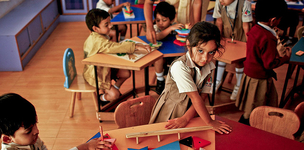
Lalith Gunaratne | 04 December 2024It is crucial to strike a balance between respect for local communities and the shared value of the enterprise.
▶
Education for equality
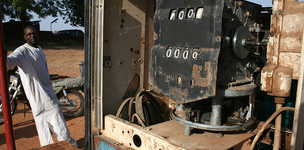
Dawood Mamoon , Syed Mansoob Murshed | 27 November 2024Developing countries should go for regional trading agreements until they raise the overall skill levels of their populations.
▶
Tackling inequality to combat poverty
Caroline Kende-Robb | 12 November 2024African governments must implement a series of policies to make sure that natural resource wealth brings more inclusive and equitable growth.
▶
Social protection as a global challenge
Bertil Videt | October 22, 2024With only a quarter of the world’s population having access to social protection, the case for expanding it is gaining ground in international discussions. The debate focuses on how best to design social protection, whether it should be universal...
▶
An unfinished symphony
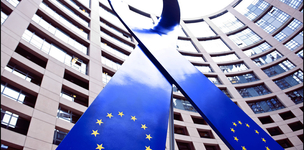
Saskia Hollander, Pearl Heinemans | September 27, 2024In the last week of September, world leaders gathered in New York for the general debate marking the opening of the 68th UN General Assembly (GA). This was an important moment for the post-2015 process, as several events were organized on the glob...
▶
What the EU could contribute, with a little more EU-phoria
Mark Furness | 10 September 2024In spite of the ongoing euro crisis, which does not leave much space for an ambitious global agenda, the EU remains a major global development actor.
▶
What have we learned?
Amarakoon Bandara | 15 August 2025Although the MDGs are arguably the most politically important pact ever made for international development, they harbor several lessons for their successor framework.
▶
Wanted: captains, pilots and mates to navigate to post-2015
Hildegard Lingnau | 14 August 2025Global goals need global policies. Governments have more to win than lose if they join forces and agree upon a single post-2015 agenda.
▶
Good job or missed opportunity?
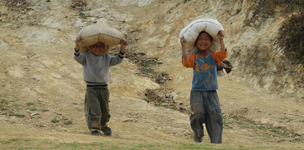
Jan Vandemoortele | 13 August 2025The High-level Panel (HLP) report has failed to transform the post-2015 debate, because it has missed the opportunity to correct the misinterpretations, misconceptions and misappropriations of the MDGs.
▶
Tying public procurement to human rights standards
Gisela ten Kate | 08 August 2025Linking public procurement to corporate compliance and engagement with international standards could spur social and inclusive progress globally.
▶
The economic crisis and the crisis of subjective well-being
Jorge Guardiola | 31 July 2025It is time to recognize the usefulness of creating institutions that aim to guarantee people's welfare instead of conditioning them to market imperatives.
▶
Institutions and economic transformation
Pradeep S. Mehta , Bipul Chatterjee | 26 July 2025Inclusive growth happens only when people have been empowered and when political and economic institutions play a much greater role in the economy.
▶
Equity should be the goal of the post-2015 agenda
Alastair Roderick | 16 July 2025Only through focusing on equity can poverty reduction and a sustainable environment be achieved in the post-2015 development framework.
▶
A window of opportunity for a post-Busan donor
Iliana Olivié | 10 July 2025As a ‘post-Busan’ donor, Spain could act as a strategic channel, providing know-how for collaboration with MICs in development.
▶
From growth to progress
Evert-jan Quak | 04 July 2025Day one of the conference Economics for a Better World ended with a number of interesting presentations on how to achieve real progress. This is a task not only for governments but also for the private sector.
▶
A look on the bright side of life
Evert-jan Quak | 04 July 2025This is the first blog post in a series from the OECD conference Economics for a Better World. Happiness versus wellbeing, are we talking about the same thing?
▶
Inclusive business needs collective action
Rutger Bults | 02 July 2025Only collective action can strengthen the inclusive business ecosystem and reach impact.
▶
Making a world fit for inclusive development
David Woodward | 29 June 2025Ensuring sufficient resources for public expenditure that are needed to spur economic transition means an ambitious global agenda. To start with the tax regime.
▶
Maximizing social impact through the power of the public purse
Evert-jan Quak | 27 June 2025Public procurement can be used to spur economic transition. But there can be a bottleneck when sustainability and inclusiveness do not converge.
▶
Global battles on the Brazilian front
Denise Ferreira da Silva | 23 June 2025In Brazil, as elsewhere, the state has no qualms about using brutal force in defence of economic projects in the interest of capital
▶
I am a Brazilian with love and pride
Conor Foley | 21 June 2025The protest movement in Brazil has been likened to an awakening giant, that is now suddenly out of control.
▶
An inclusive future demands political courage
Evert-jan Quak | 19 June 2025To achieve inclusive development the European Union (EU) needs to reframe its economic policy and reconsider politically sensitive issues.
▶
The economics of peace and violence
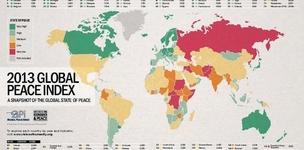
Karlijn Muiderman | 18 June 2025The launch of the seventh Global Peace Index and the integration of socio-economic indicators.
▶
Japan’s strategy to include the disabled
Sachiko Nakagawa | 19 June 2025Disabled people can be included in society through work integration social enterprises. What are Japan’s lessons learned?
▶
Planet earth is wage-led!
Özlem Onaran | 17 June 2025Economic growth should go hand in hand with an improvement in wage share and vice versa. However, current economic policy does not.
▶
A Divided Town
Yedan Li | 06 June 2025If China is the world’s factory, then Qingyang town represents the forefront of production.
▶
Cracks in Turkey’s image as role model
Bertil Videt | 04 June 2025Turkey needs to address human rights and inequality to be a role model for emerging powers.
▶
The inequality of macroeconomic risk
Nick Galasso | 27 May 2025Food price hikes, natural disasters, environmental degradation, and financial crises share at least two things in common: They’re on the rise, and they unequally burden the poor.
▶
Progressive policies and the Palma
Alex Cobham , Andy Sumner | 27 May 2025The failure of effective direct taxation is the central explanation for much higher final income inequality. Therefore Cobham and Sumner argue in favour of more fairness in tax systems through metrics.
▶
From trickle-down to bubble-up
David Woodward | 23 May 2025Economic policy should focus on poverty reduction rather than on growth and should start in rural areas. First of two blog posts by David Woodward.
▶
An inclusive economy? Yes, but globally!
Rolph van der Hoeven | 23 May 2025Policies to improve inclusiveness should rethink the model of financial globalization in the same way as industrialization was embedded in national welfare states.
▶
What inequality means for children
Paul Dornan | 21 May 2025Inequality of opportunity provides a helpful way of framing the debate, particularly so as it shows the agreement that circumstances should not prohibit the fulfillment of talent. For children, early inequalities in learning or nutrition have seri...
▶
Towards an inclusive economy
Sara Murawski | 15 May 2025‘Spurring economic transition’ is the follow-up to The Broker’s debate on inequality. What are the most important conclusions of the inequality debate that it needs to address?
▶
Microfinance is blind to aspects of inclusion
Hebe Verrest | 15 May 2025The problems experienced by microfinance are a good example of what is needed to achieve an inclusive economy. For example, it tends to be blind to social and psychological costs.
▶
The false tradeoff between growth and inclusion
Dean Baker | 15 May 2025There is a common tendency to view growth and equity as competing goals, including by many of those who have strong concerns about the latter. This is unfortunate since it is likely to lead to bad policy and horrible politics.
▶
A post-2015 development goal for inequality?
Francisco Ferreira | 15 May 2025The debate on a post-2015 inequality target is missing a fundamental point: what inequality would we like to eliminate?
▶
Spurring economic transition
May 14, 2025How can we create a more inclusive economy and what obstacles lie in the way? This debate seeks answers.
▶
Navigating the post-2015 debate
Bertil Videt | May 08, 2025In its post-2015 dossier, The Broker guides you through the many discussions about development after the United Nations Millennium Development Goals (MDGs) expire in 2015. The aim of the post-2015 dossier is to provide an overview of the debate, t...
▶
Ending hunger within a generation
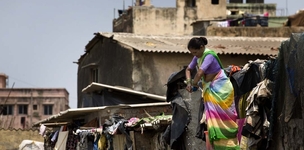
Evert-jan Quak | May 07, 2025Halving extreme poverty and hunger is the aim of Millennium Development Goal one. Although this goal is in reach, feeding a growing world population with good quality food remains a major challenge. Especially if you take into account climate chan...
▶
MDGs have ignored inequality
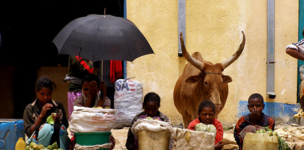
Sara Murawski | May 07, 2025Social exclusion and inequality have been neglected in the Millennium Development Goal framework and their structural causes need to be addressed in a systematic way. That is the main conclusion from the UN Development Programme’s consultation on...
▶
Inequality is not only about poverty
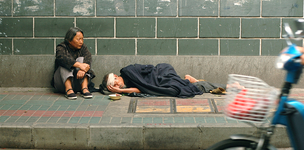
Lars Engberg-Pedersen | 29 April 2025The global development framework for the coming years cannot ignore global inequality if it should constitute a relevant and legitimate set of development goals in a globalised world.
▶
A new ‘median’ inequality indicator, designed to support poverty eradication
Amanda Lenhardt , Andrew Shepherd | 23 April 2025For a national policy maker it is possible to think about raising the income levels of the bottom 10% or 20% toward the middle of the distribution. The poorest can be brought nearer the poverty line through measures like cash transfers.
▶